In current conditions, most FPV pilots are constantly confronted with the effects of electronic warfare (EW) systems. The operation of EW leads to the suppression or complete loss of control and video transmission signals. In such situations, a drone often loses stability, deviates from its intended trajectory, or becomes uncontrollable, ultimately resulting in the loss of the aircraft. For military units, this means not only material losses, but also disrupted missions and increased risks for operators.
In response to this challenge, we at VGI-9 have developed a solution called “Cruise Control”. This module enables drones to traverse zones of active EW interference, maintain flight stability even during temporary loss of communication, and significantly increase the chances of Ukrainian pilots successfully completing their missions.
This is the first solution of its kind in Ukraine and one of the first in the world to be implemented specifically at firmware level rather than through additional hardware.
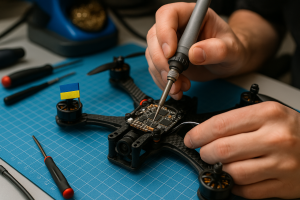
VGI-9’s “Cruise Control” is realised exclusively at the level of the flight controller firmware. The solution requires no additional microcomputers, cameras or physical modifications to the airframe. Once the firmware has been integrated, the aircraft gains a new degree of autonomy and predictable behaviour.
How Cruise Control Works
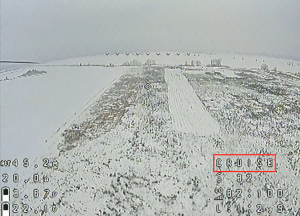
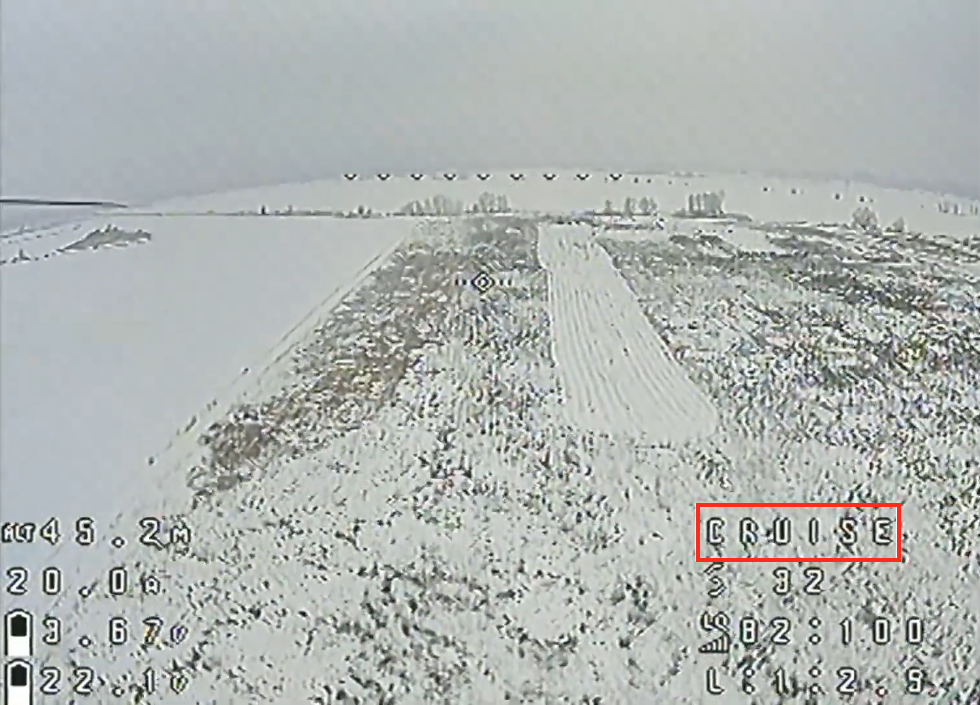
The operating principle is both straightforward and technologically precise. The pilot raises the aircraft to the required altitude, sets the azimuth and speed, and then activates Cruise Control mode. From that moment on, the drone automatically maintains the designated parameters: altitude, speed and direction.
Maintaining the preset flight parameters does not depend on the availability of a control link or video signal. Even if control is lost due to electronic warfare interference, the drone continues its steady movement. In this way, we eliminate the loss of the aircraft in situations where it had previously been an almost inevitable risk.
Stability, Energy Efficiency and Control
We have also paid particular attention to flight smoothness. In manual mode, the operator constantly makes micro-adjustments: levelling the altitude, compensating for deviations in heading, and stabilising speed. This places additional strain on the pilot and increases the drone’s battery consumption.
In Cruise Control mode, movement becomes steady, without oscillations or abrupt fluctuations. As a result, battery usage is reduced, allowing the drone to cover a greater distance.
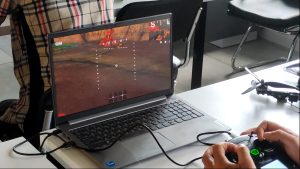
At the same time, we do not restrict the operator: when a communication link is available, the pilot can adjust the flight by azimuth, altitude or roll, and at any moment fully regain manual control. The mode can then be reactivated, and the drone can continue towards its designated point.
Thus, Cruise Control does not replace the pilot; rather, it enhances their capabilities and enables them to focus on executing the combat task at the decisive moment.
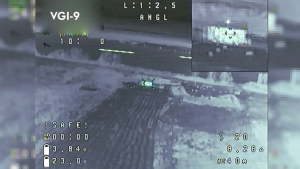
To better understand how VGI-9 is advancing drone autonomy and combat effectiveness, we recommend reading our recent announcement: “Night Target Guidance: The VGI-9 Team Launches Serial Production of a Module.”
Versatility and Protection of the Solution
The VGI-9 solution requires no additional configuration or calibration. It operates with equal stability under both minimal and maximum permissible payloads. The firmware is compatible with FPV platforms of various sizes (7, 8, 10, 13 and 15 inches), allowing it to be integrated into a wide range of combat configurations.
The team has placed particular emphasis on ensuring comprehensive firmware protection, preventing its copying or use by the enemy in the event that a drone is lost in hostile territory. As of today, the module is already being deployed in serial production by manufacturers such as “Vyrii” and “General Chereshnia”, and its effectiveness has been confirmed under real operational conditions.
At VGI-9, we are convinced that the autonomy of the modern FPV drone should evolve not through increasing structural complexity, but through deep engineering refinement. The “Cruise Control” module represents a step towards more survivable, longer-range and more predictable systems in the most demanding operational environments.
Frequently Asked Questions
Are there any limitations regarding types of flight controller?
At present, there are no restrictions concerning flight controller types. The “Cruise Control” module integrates with all current platforms. The algorithm has been implemented in such a way that it operates within the standard architecture of modern flight controllers, without the need for additional computational modules or hardware modifications. The system functions within the controller’s standard configuration.
What is the maximum duration of signal loss during which flight stability is maintained?
In “Cruise Control” mode, the drone maintains the preset parameters (altitude, speed and direction) throughout the entire flight, regardless of the connection with the operator. The only practical limitation is the battery’s energy capacity. As long as there is sufficient battery charge, the aircraft continues to move according to the fixed parameters. This allows it to traverse zones of active electronic warfare without the risk of losing control.
How does the system behave under changing wind conditions while traversing an EW zone?
Wind conditions directly affect the flight trajectory. Since the current configuration lacks an optical or GPS-based course correction channel, some lateral drift of the drone under the influence of crosswinds is possible. At the same time, altitude and speed remain stable according to the preset parameters. When a connection is available, the operator can make corrections along the yaw and roll axes, as well as altitude, even while remaining in “Cruise Control” mode.
Has the solution undergone field testing under active enemy EW?
Yes. The “Cruise Control” module has undergone field testing in real combat conditions, including under the influence of active enemy electronic warfare systems. The solution is already in active use by Ukrainian units at the front. Operational experience has confirmed the module’s effectiveness in traversing signal suppression zones and reducing the risk of aircraft loss. The solution is now integrated into the serial production of manufacturers such as “Vyrii” and “General Chereshnia”.
For Drone Manufacturers: How to Integrate VGI-9’s “Cruise Control” into Our Solutions
Integration is carried out in collaboration with VGI-9’s technical team. The first step is to submit an application via the company’s official website. This is followed by a technical consultation, during which the platform configuration is analysed and the integration format is agreed upon. Since the solution is implemented at the firmware level, no hardware modifications to the drone’s design are required. The VGI-9 team provides support throughout implementation, testing, and deployment into serial production.
Contact us to get detailed information about the VGI-9 drone guidance system.
Follow our updates on social media and YouTube – there you will find:
✅ Exclusive materials on the development, testing, and combat use.
✅ Useful analytical content on the war and the role of FPV drones in modern combat operations.
✅ The latest news and insights from the world of military technologies.F
📌 Join us:
🔗 YouTube: VGI-9 on YouTube
📸 Instagram: We are on Instagram
🎯 TikTok: We are on TikTok