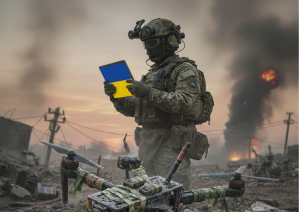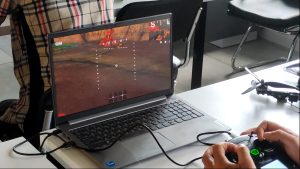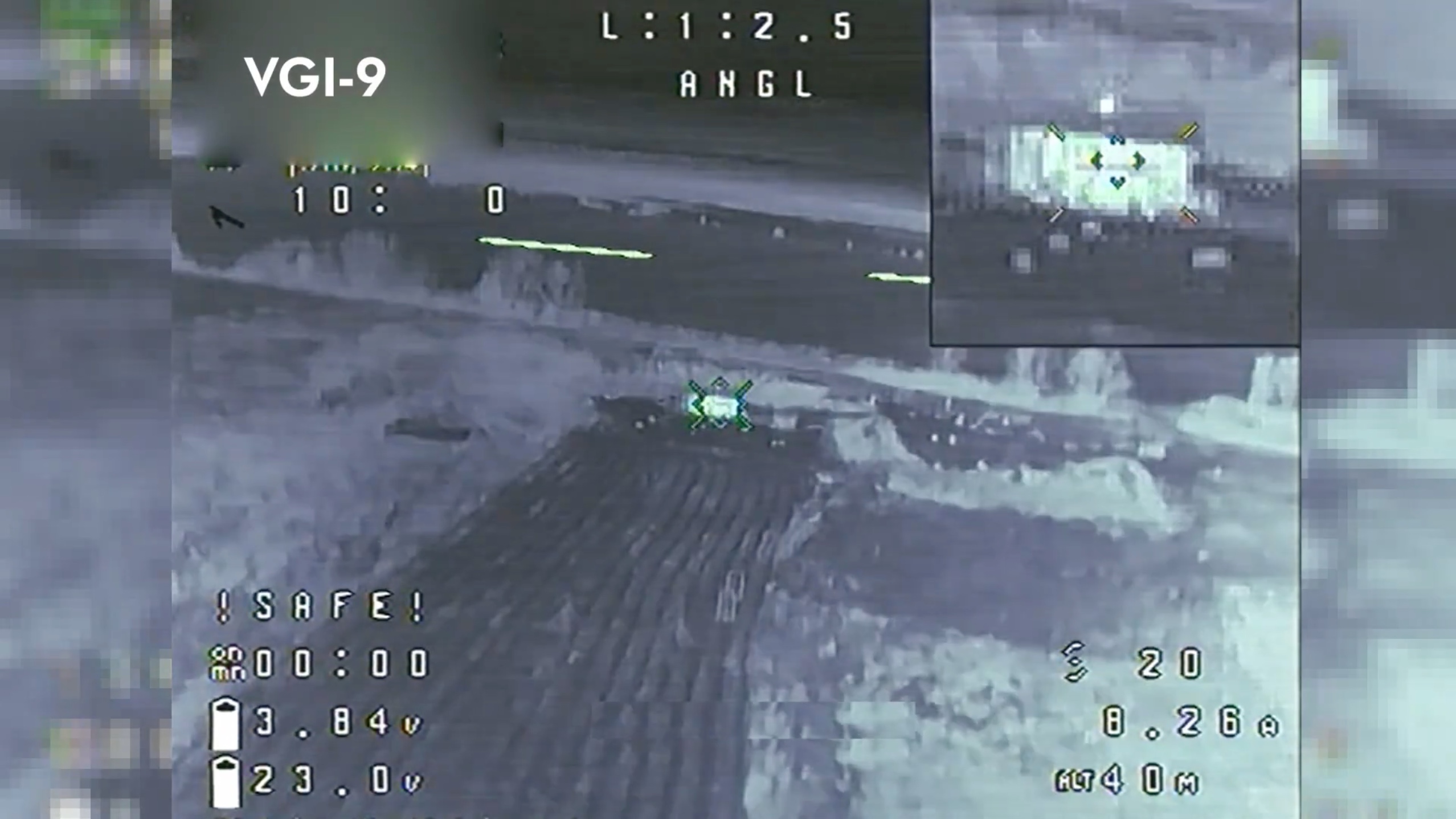
VGI-9 Night Target Guidance, also referred to as the night module, is a logical and technological extension of the daytime FPV drone guidance system. Its primary purpose is to ensure effective target engagement during nighttime operations while maintaining ease of use for the operator.
FPV drones equipped with the VGI-9 night target-guidance system are already available for purchase through partner companies.
What Is Night Target Guidance
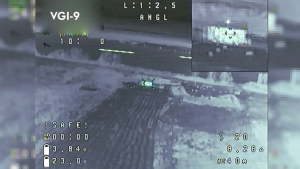
Night target guidance is a hardware–software system that is integrated directly into an FPV drone. Functionally, it follows the same logic as daytime guidance, but the key difference lies in the type of sensor used: instead of a standard digital camera, a thermal imaging camera is employed.
As a result, the system typically consists of:
- thermal imaging camera;
- microcomputer;
- 3D-printed housing.
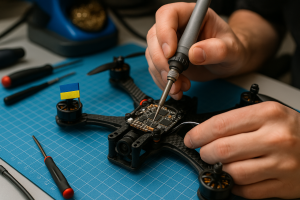
The system is connected to the drone’s flight controller, after which specialized software is installed. Once this is done, the drone is ready for operation — with no calibration, presets, or complex configuration required.
How Target Acquisition Works
The operating logic of the night module is nearly identical to that of the daytime system:
- The operator launches the drone into the air.
- Visually acquires the target and aligns the targeting indicator accordingly.
- Presses the “Lock” button.
- The drone then independently completes the strike, even if the connection with the operator is lost.
Once the target is locked, the system no longer depends on radio-link stability. This is critical in conditions of active electronic warfare (EW), poor radio horizon, or when operating at extreme distances.
To better understand the technological philosophy behind autonomous engagement systems, read our in-depth interview with the VGI-9 leadership: VGI-9 CTO on Revolutionizing Drone Targeting in Combat
Why Thermal Imaging Is a Decisive Advantage
A thermal imaging camera combined with a target-guidance system provides a near-guaranteed ability to engage both stationary and moving targets.
Thermal imaging fundamentally changes the nature of observation:
- warm objects (people, vehicles, engines) stand out clearly against the background;
- the higher the temperature, the brighter the object appears;
- concealment, shadows, camouflage, and darkness lose their effectiveness.
In practice, it is significantly harder to hide from a drone equipped with a thermal imaging camera. Such a drone is also more difficult to detect at dusk or at night and to shoot down using shotguns commonly employed by infantry — both Ukrainian and enemy forces.
Unlike daytime guidance, the night module delivers round-the-clock effectiveness — 24/7.
Ranges and Limitations
The technical parameters of the night target-guidance system are comparable to those of daytime systems:
- effective target lock range — up to 3 km;
- operating altitude — up to 1 km.
In practice, there is only one real limitation: the operator must visually detect the object (on the thermal image) and lock onto it. The system requires no additional conditions or configuration.
Cruise Control and Operator Freedom
It is important to emphasize that night target guidance does not replace the operator — it expands the operator’s capabilities.
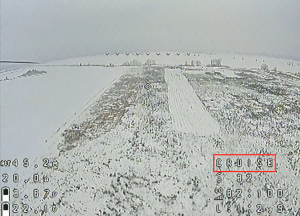
The night guidance system also supports a Cruise Control function, which is used to pass through areas of active electronic warfare (EW) and to reduce the load on both the drone (by conserving battery power) and the operator during long-range flights.
At the same time, Cruise Control prevents the drone from being lost during sudden enemy EW attacks. The drone automatically switches to Cruise Control mode, maintaining the preset flight direction and speed. Once the communication link is restored, the operator can return to manual control.
For a broader perspective on evolving aerial defense technologies, read our analysis: Can Interceptor Drones Protect Ukraine’s Skies?
Frequently Asked Questions About Night Target Guidance
“Night” vs. “Daytime” Target Guidance — Can One Be Considered More Accurate?
No. Target engagement accuracy is the same. The key factor is successful target lock. After that, the same autonomous engagement logic takes over.
The difference lies not in the algorithms, but in the type of visual information available to the operator:
- daytime guidance provides a familiar full‑color image with high scene detail;
- night guidance provides a thermal image, where targets are distinguished by their temperature signature.
In some scenarios, thermal imaging allows for better target identification through concealment, while in others, a daytime camera provides more contextual information for situational awareness. The choice depends on conditions, not on the system’s “accuracy.”
Do Weather Conditions (Rain, Snow, Fog) Affect Target Lock Stability?
Yes, weather conditions can have an effect — but it is not critical.
- Fog reduces detection and lock range, as the operator’s visual perception of the target is impaired.
- Rain or snow can complicate the image. For example, a drop of water on the drone’s camera may affect tracking stability.
At the same time, the key point remains: once the target is locked and control is handed over to the drone, engagement proceeds autonomously and does not depend on the quality of the image seen by the operator.
Is There a Risk of Interference from External Thermal Sources or Decoys?
In practice, such interference is limited. An operator working with thermal imagery can distinguish a static heat source (for example, a stove or a heated object) from a real target — such as equipment or a person with a characteristic shape and behavior.
Thermal target guidance does not operate “blindly”: the decision to lock onto a target is always made by the operator, not by the system.
In Which Scenarios Does Night Target Guidance Offer the Greatest Advantage?
Night target guidance delivers the greatest impact in the following scenarios:
- deep nighttime conditions (effectively enabling 24/7 operations);
- reduced visibility due to fog, rain, or snow;
- engaging targets attempting to hide in darkness or concealment.
In these situations, the thermal imaging camera removes the key limitation of daytime systems — their dependence on ambient lighting.
How Will the Target-Guidance System Evolve?
Key areas of development include:
- integrating daytime and nighttime vision into a single system;
- removing current limitations of combined use;
- expanding autonomous functions: autonomous target search, classification, and engagement.
In other words, the system is moving toward greater autonomy and reduced dependence on environmental conditions, without complicating the operator’s workload.
Where Can VGI-9 Drones with Night Target Guidance Be Purchased?
Supplies are made through manufacturers and integrators of FPV solutions.
If you are interested in purchasing drones equipped with the night target-guidance system, please contact us using the information provided on our website.
Contact us to get detailed information about the VGI-9 drone guidance system.
Follow our updates on social media and YouTube – there you will find:
✅ Exclusive materials on the development, testing, and combat use.
✅ Useful analytical content on the war and the role of FPV drones in modern combat operations.
✅ The latest news and insights from the world of military technologies.F
📌 Join us:
🔗 YouTube: VGI-9 on YouTube
📸 Instagram: We are on Instagram
🎯 TikTok: We are on TikTok