“Shvidun” interceptor drone: a focus on protecting the sky.
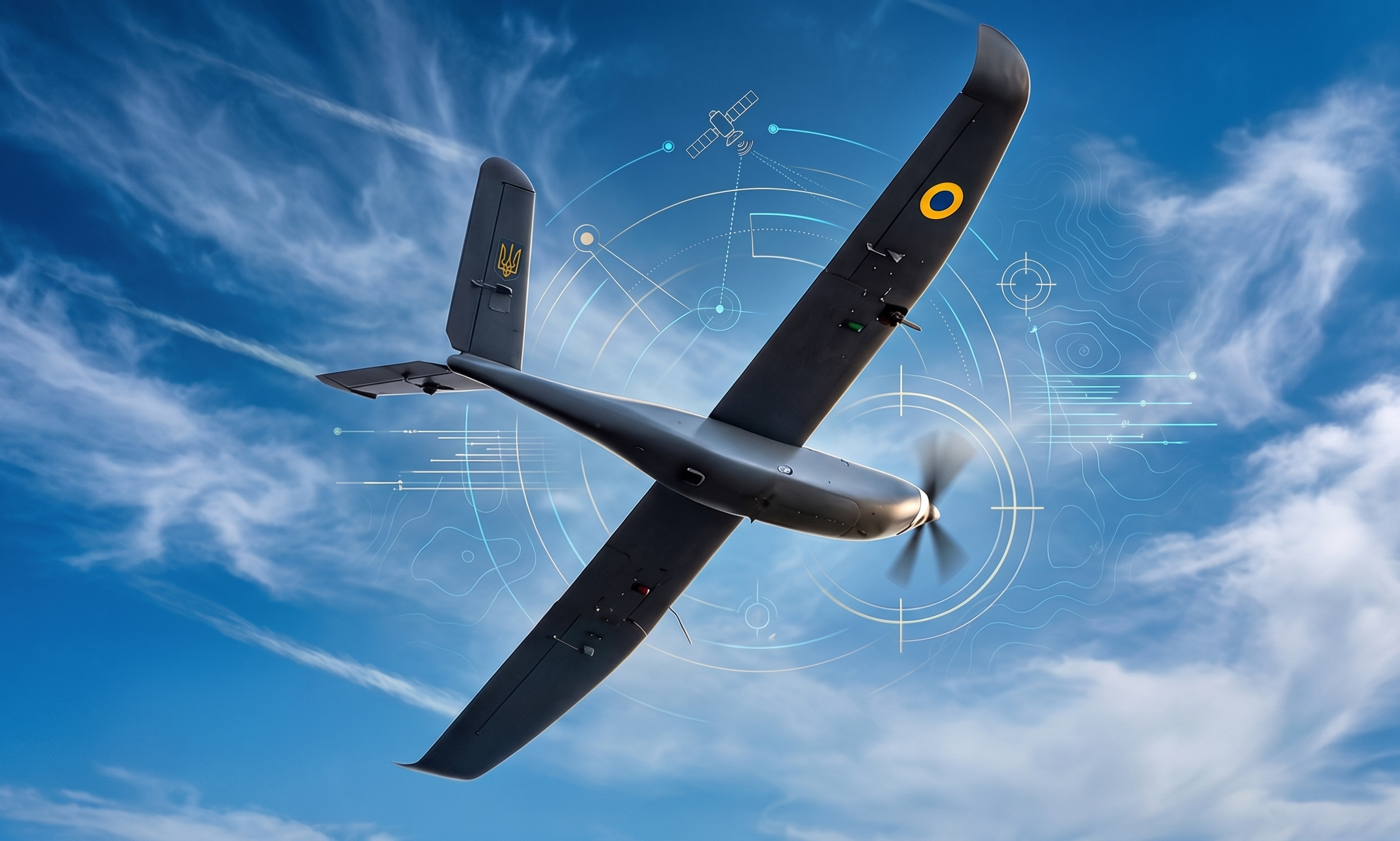
On March 31, 2026, the Ministry of Defense of Ukraine approved the new unmanned aerial system “Shvidun” for operational use.
It is an interceptor drone designed to destroy threats such as Shahed-136, “Geran,” “Gerbera,” as well as reconnaissance drones like Zala and Supercam.
From a technical standpoint, “Shvidun” is a relatively compact but effective system:
• weight of about 8 kg;
• speed exceeding 250 km/h;
• operational range of more than 70 km.
It can operate at altitudes of up to 6 km and remain airborne for more than two hours. Notably, the design enables reuse — the drone can be landed if the target is no longer tracked.
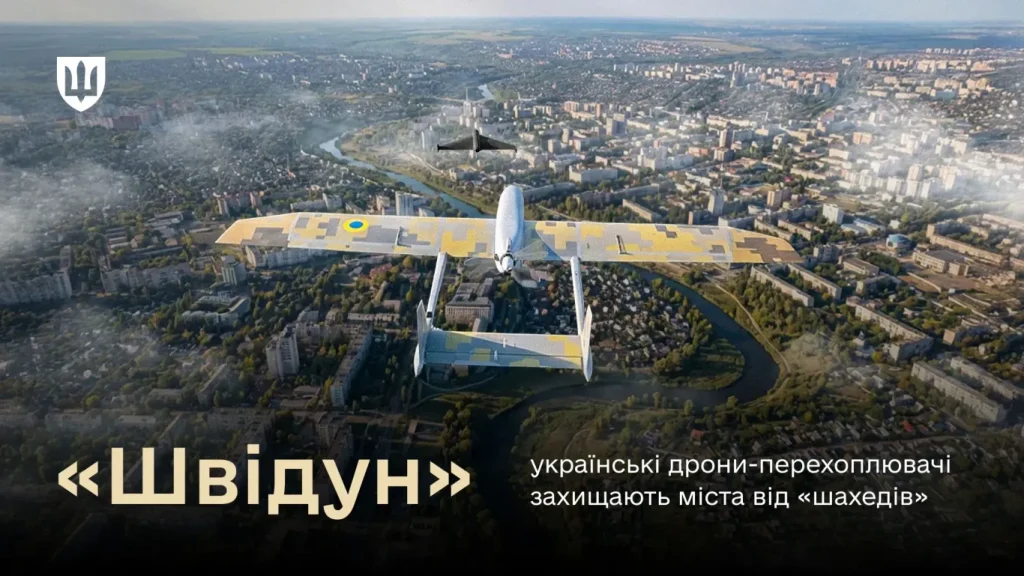
However, its key feature is effectiveness. With the help of these drones, around one hundred enemy UAVs have been destroyed.
Scaling the industry: 450 companies and 7 million drones.
Today, around 450 companies in Ukraine are already engaged in drone production, of which 40–50 can be considered top players, Volodymyr Zelenskyy shared in an interview.
This means that the unmanned systems market has effectively become the largest industry in the country — not only in terms of the number of manufacturers, but also in terms of investment volumes. Importantly, this process is not slowing down; on the contrary, it is entering a phase of active growth.
Ukraine has also announced its intention to produce more than 7 million unmanned systems in 2026, as Deputy Minister of Defense Serhii Boiev noted. This reflects a systematic expansion of production capacity, which has become a logical continuation of previous years.
To understand the scale: in 2025, the Armed Forces of Ukraine received around 3 million FPV drones — almost 2.5 times more than in 2024. This was reported by Defense Minister Denys Shmyhal. The overwhelming majority of these unmanned systems were domestically produced.
Against this backdrop, the stated figure of over 7 million drones in 2026 appears to be a significant leap in development, as well as a continuation of the scaling trend that Ukraine has been gradually building in its defense industry.
Drones are now officially defined as the foundation of asymmetric defense. It is precisely they that have made it possible to create the so-called “kill zone” with a depth of up to 20 km, which restrains the enemy. The next goal is to expand it to 100 km, which would mean the ability to systematically strike targets at operational depth.
Entering foreign markets: from exports to joint production.
Another important shift is that Ukraine is effectively opening a new market — the export of its own unmanned systems. This was announced on February 8, 2026, in a Telegram post by Volodymyr Zelenskyy.
In 2026, the launch of ten export hubs is planned in the Baltic and Northern European countries. In addition, Ukrainian drones are already beginning to be produced abroad — in particular in Germany and the United Kingdom.
According to the President, this is not just about selling equipment, but about deploying an entire ecosystem of Ukrainian technologies in Europe. In fact, Ukraine is exporting not only drones, but also experience in modern technological warfare.
Europe’s security is increasingly dependent on technology, and Ukrainian developments are already becoming part of it.
In parallel with exports to Europe, Ukrainian manufacturers are also entering the U.S. market — but in the form of joint production.
The Ukrainian company “General Chereshnya” announced a partnership with Wilcox Industries Corp. to establish drone production in the United States.
The project involves FPV drones and interceptors developed by the Ukrainian team, while manufacturing will take place at American facilities in New Hampshire.
Record purchases of multicopters.
Alongside the development of more complex and specialized systems, the first quarter of 2026 confirms another important trend — the critical role of “simple” multicopters on the battlefield.
In January–February, the Defense Procurement Agency signed contracts for a record number of drones, including models such as DJI Mavic, Autel EVO, and DJI Matrice. As a result, the military will receive at least twice as many multicopters as in the same period last year, according to Defense Minister Mykhailo Fedorov.
These drones are not high-tech “exotics,” but they are the ones that perform key daily tasks on the front line:
• reconnaissance; artillery correction;
• engaging infantry with dropped munitions;
• mine deployment;
• improving the accuracy of FPV drones.
In fact, multicopters form the tactical level of warfare — at a depth of up to 5 km. Demand for them continues to grow, as losses of such drones during combat missions remain high.
Drone swarms: the next stage in the evolution of interceptors
If interceptor drones from P1SUN, “Wild Hornets,” and “General Chereshnya” show what interceptors are today, then “smart” swarms represent what they will be tomorrow.
According to Business Insider, in Ukraine, several companies within the Brave1 cluster are working on developing next-generation interceptor drones capable of operating as a single system.
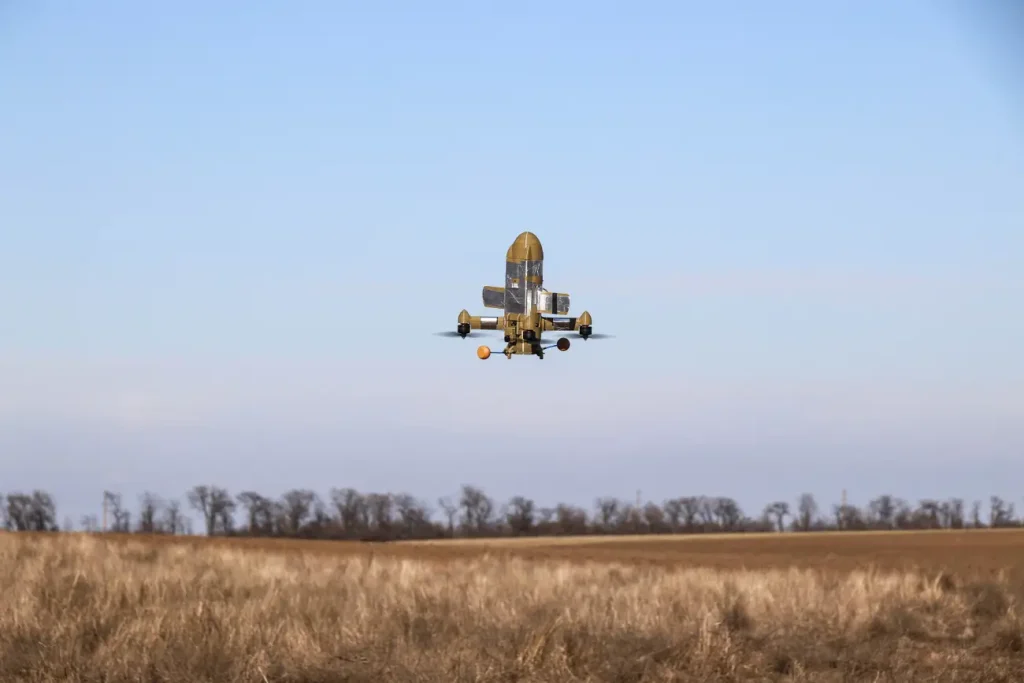
This represents a fundamentally different logic of use: not one drone — one operator, but one operator — an entire group of unmanned systems. They will be able to coordinate actions in real time, distribute targets, and even interact with each other without direct human intervention.
In the long term, this could lead to partial autonomy — where drones independently carry out interceptions and strikes on ground targets, while a human only defines the targets. This approach does not replace the operator, but significantly reduces the workload and allows air defense to scale without a proportional increase in personnel.
The key focus in the development of unmanned systems today is practical solutions for scaling.
In March 2026, Swarmer became the first Ukrainian defence tech company to go public — its shares began trading on the Nasdaq Capital Market under the ticker SWMR, according to Forbes. The company plans to raise around $15 million, which will be directed toward product development, team expansion, and integration with drone manufacturers.
In practice, this means that:
• operators are no longer tied to the front line;
• the risk of personnel losses is reduced.
Business in air defense: an experimental model with open questions
Another important trend of the first quarter is the expanding role of the private sector in air defense.
The government has updated the rules of an experimental project that allows critical infrastructure enterprises to participate in the air defense system. Now private companies, regardless of ownership form, can create their own air defense units.
This represents a de facto shift in the model: the protection of the skies is no longer exclusively a state function, but becomes a shared responsibility of the state and business. The question of the appropriateness and effectiveness of involving businesses in such functions still does not have a clear answer.
The system remains centralized — all decisions are made under the control of the Air Force Command of the Armed Forces of Ukraine, and personnel undergo training and certification. The state can also temporarily transfer weapons and ammunition to enterprises to carry out assigned tasks.
This model is already functioning in practice: in particular, in the Kharkiv region, teams from private companies are participating in intercepting enemy targets, including “Shaheds” and reconnaissance drones.
An overview of how Russia scaled its Shahed drone program — from initial deployments to mass production and systematic use in warfare.
The key question for this model is its long-term effectiveness. Conclusions about the efficiency of such an approach can be drawn no earlier than in several months, once systematic data on its performance becomes available.
A global coalition against “Shaheds”.
Against the backdrop of the war in the Middle East, Ukraine is expanding international cooperation in the field of defense technologies. According to Volodymyr Zelenskyy, Ukraine is actively working with countries in the Middle East — in particular Saudi Arabia, United Arab Emirates, Qatar, and Jordan — on countering Iranian drones and missiles.
Negotiations are also underway with other states, including Turkey and countries beyond the region.
This is an important signal: the threat of “Shaheds” is no longer a local problem for Ukraine. It is becoming a global challenge, and Ukraine’s experience in countering such attacks is turning into an export product — alongside the drones themselves.
Ukrainian drone production is expanding.
In 2026, Ukraine plans to launch ten drone production facilities across Europe. This involves establishing joint ventures with European partners that will allow unmanned systems to be scaled not only for Ukraine, but also for its allies.
One example of such cooperation is Germany, where the joint venture Quantum Frontline Industries — created by the German company Quantum Systems and Ukraine’s Frontline Robotics — managed to launch production in less than two months after its announcement.
In most cases, the model looks as follows: European partners provide infrastructure and resources, while Ukraine contributes technology and combat experience. As a result, production becomes faster, more scalable, and less vulnerable to risks.
In parallel with the expansion of Ukrainian technologies into Europe, the reverse process is also taking place — international companies are increasingly integrating into the Ukrainian defense market.
The German company Quantum Systems, one of the key manufacturers of reconnaissance unmanned systems, plans to double UAV production in Ukraine in the near future.
The company has been supplying Vector drones since 2022, but over this time it has not limited itself to deliveries alone. A full infrastructure is already operating in Ukraine: a service and logistics center, training programs for operators, a repair base, and even an R&D center. Later, its own production facility was also added to this system.
Ukrainian drones are moving to a new level
If we bring together all the events of the first quarter of 2026 into a single picture, it becomes clear: Ukraine’s drone industry is experiencing a moment of qualitative leap.
We can see several parallel processes:
• technological advancement (interceptors, swarms, remote control systems);
• mass production (millions of drones and hundreds of companies);
• new models of use (air defense with business participation);
• globalization (exports, joint production, international partnerships).
How “Cruise Control” helps FPV drones stay on course even under heavy electronic warfare.
And most importantly — these processes no longer exist separately. They are merging into a single system that is rapidly scaling and extending beyond Ukraine.