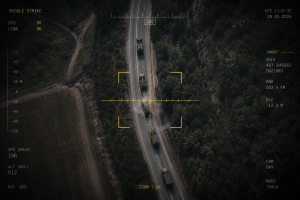
The widespread use of electronic warfare (EW) systems on the battlefield in 2023–2024 significantly limited the effectiveness of traditional FPV drones controlled via radio channels. Under conditions of active signal jamming, operators lost control of UAVs, which reduced their operational efficiency.
In response to these limitations, fiber-optic drones began to be actively deployed. In such systems, communication between the operator and the drone is not transmitted via radio waves but through a thin fiber-optic cable that unspools during flight. This solution allows stable control even in areas with intense EW activity and effectively eliminates the impact of radio interference on the communication channel.
Fiber-optic drones became one of the most discussed topics in mid-2024, and their numbers have only continued to grow since then. They have gained a reputation as one of the most effective weapons. But is that really the case?
Countermeasures: What Actually Works?
Fiber-optic drones have undeniable technological advantages. However, they are not completely invulnerable. Traditional electronic warfare methods do not work against them, which limits the range of effective countermeasures.
Why are fiber-optic drones getting so much attention? In a separate piece, we break down how they could impact the course of the war.
Military units are developing practical solutions — from engineering barriers to tactical approaches and physical destruction of drones. Below are the countermeasures already being applied in practice to reduce the threat posed by such systems.
Protective Nets
One of the simplest yet quite effective countermeasures against FPV drones is the use of physical barriers — specialized anti-drone nets. These passive engineering solutions are increasingly common: nets are stretched over positions or roads to physically block drones from reaching their targets.
Today, such protection can be seen across many frontline areas. Roads between Druzhkivka and Kramatorsk are covered with nets, and similar structures are deployed in Dnipropetrovsk, Donetsk regions, and beyond. Military experience shows this to be one of the most scalable and practical solutions.
Nets are not only used over roads. They are also effective above dugouts, shelter entrances, and equipment positions. Installed on metal cables or poles, they form a kind of “dome.” When a fiber-optic drone hits such an obstacle, it either detonates prematurely or becomes entangled before reaching its target.
However, nets are not a universal solution. Experts note they are only effective with dense coverage — even small gaps can allow drones to pass through.
Mobile Fire Groups
Another method of countering fiber-optic drones is the use of mobile fire groups. These units consist of several soldiers equipped with small arms and observation tools. Their task is to detect drones quickly and destroy them before they reach their target.
The main challenge lies in the speed and small size of drones. FPV drones can fly at low altitudes and maneuver sharply, making them difficult to detect. The effectiveness of mobile groups increases when integrated with other systems — observation posts, radars, or reconnaissance drones.
For example, some Ukrainian units use radar systems for early detection, followed by engagement with small arms. In frontline footage, mobile fire groups can be seen shooting down FPV drones during approach.

This tactic is actively used, especially to protect logistics routes, equipment convoys, and field depots.
Modern mobile groups are not limited to firearms. They are becoming multifunctional units capable of countering drones in various ways. Net guns are also actively used — with successful examples demonstrated in footage by Ptashka Drones.
Emerging Solutions Against Fiber-Optic Drones
A promising direction is the use of laser systems. A laser can target not only the drone itself but also its most vulnerable component — the fiber-optic cable that carries control signals.
When the laser hits the cable, it overheats and suffers physical damage, instantly breaking the connection between the drone and the operator.
However, detecting a thin fiber in flight and accurately targeting it with a laser remains a complex technical challenge. Still, advancements in short-range laser air defense systems may make this method more viable in the future.
Physical Damage to the Fiber-Optic Cable
A defining feature of these drones is the thin fiber-optic cable that unspools during flight and maintains communication. This also creates a potential weak point.
Like any cable, it can be physically damaged — for example, cut. The result is immediate loss of control, causing the drone to crash or become uncontrollable.
The cable can be cut by another drone or with sharp “traps.” One such solution is barbed wire, which can damage the fiber upon contact.
In practice, this method is difficult to implement: the fiber is extremely thin, and the drone moves at high speed, requiring high precision. Still, even with limited effectiveness, such physical methods contribute to reducing the number of operational enemy drones.
Camouflage and Tactical Adaptation
Another important element of countering fiber-optic drones is tactical camouflage. The effectiveness of such drones depends heavily on the operator’s ability to see the target through the onboard camera. Reducing visibility directly reduces strike effectiveness.
Measures include camouflage nets, changing the color of equipment, hiding positions under natural cover, and creating decoys.

For example, equipment is often placed under dense camouflage nets or in reinforced shelters. Decoy equipment is also widely used to mislead drone operators and force them to waste munitions on false targets.
Camouflage nets can serve a dual purpose: concealing positions and occasionally physically interfering with drones. The best results come from combining camouflage with other measures — engineering protection, nets, and dispersal of assets.
What Q1 2026 Reveals About Ukraine’s Drone Ecosystem? — read in our recent blog post to be aware of the key trends in Ukraine-Russian war.
Conclusion
Fiber-optic drones have become a serious challenge in the current phase of the war, particularly in areas saturated with electronic warfare. They reduce the effectiveness of one of Ukraine’s key defensive tools — EW — and force a shift toward more complex, layered countermeasures.
At the same time, the battlefield is already adapting. Nets, mobile fire groups, tactical camouflage, and experimental solutions are being deployed not as isolated fixes, but as part of a system defense approach.
None of these methods provides full protection, but together they create friction that reduces the effectiveness of attacks. Importantly, economics may also play a decisive role: fiber-optic systems are more expensive and harder to scale, which limits their mass deployment. This suggests that fiber-optic drones will not replace other technologies, but rather integrate into a broader, constantly evolving ecosystem of drone warfare — where advantage is always temporary, and adaptation remains the ключовий фактор.