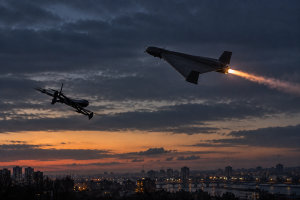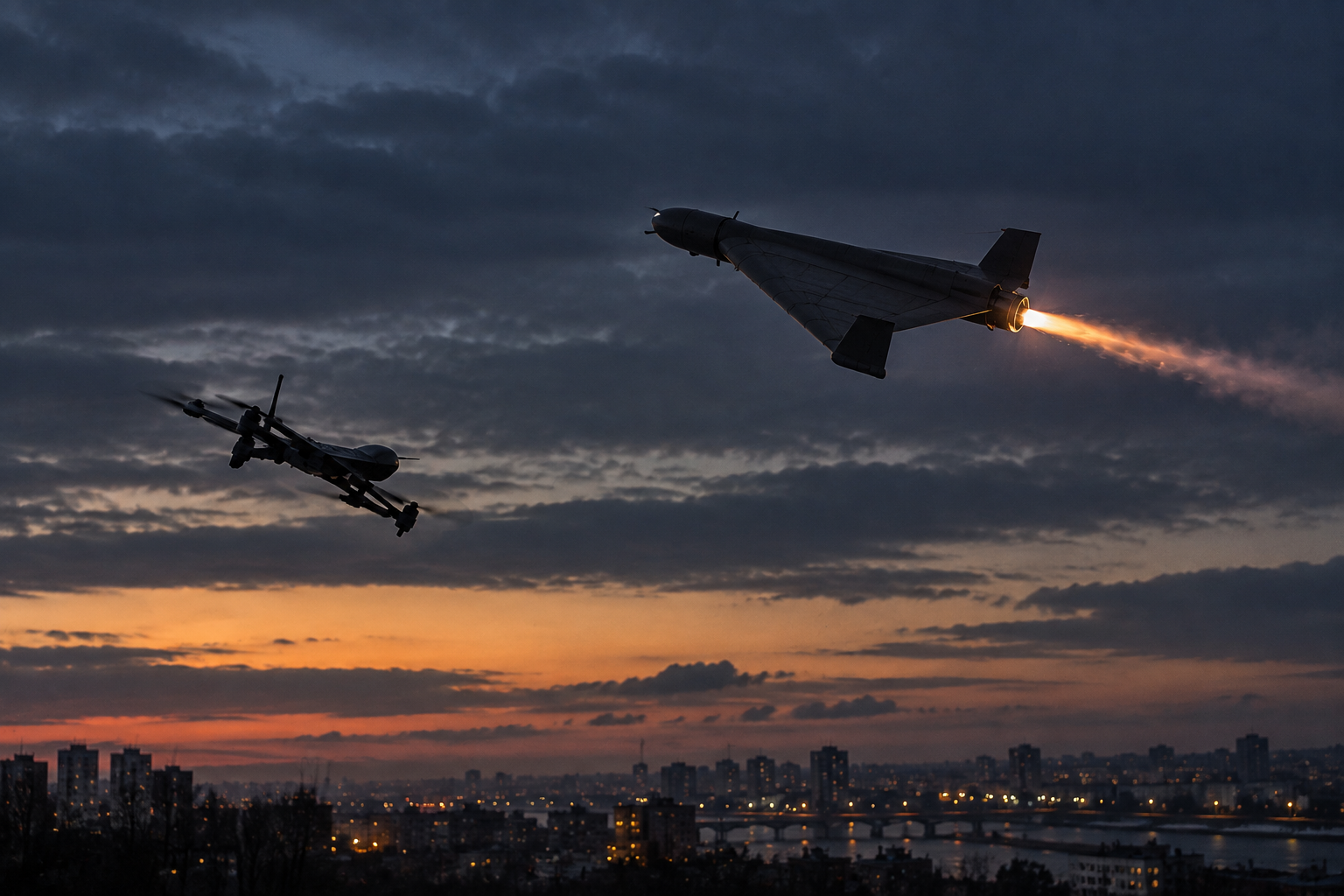
September 2026 was one of the most difficult months for Ukraine in its fight against aerial attacks. Russia began using jet-powered Shaheds on a large scale, striking deep inside Ukrainian territory. For now, Ukrainian air defenses intercept only about half of these drones. By comparison, the interception rate for conventional Shaheds exceeds 90%.
This article looks at what jet-powered drones are, how they evolved, and what can be done to counter them.
Contents
How the Geran Emerged: From Iran’s Shahed-136 to the Jet-Powered Geran-5
The Shahed was developed in Iran and was first tested by the Houthis against Saudi Arabia in 2019. Its concept is simple: a relatively inexpensive drone with a long range and a warhead can strike targets far behind the front line while forcing the enemy to spend much more expensive resources to intercept it.
Russia received its first batches of Shahed-136 and Shahed-131 drones in mid-2022. By September, Ukrainian forces had publicly documented the use of Shahed-136 drones in Ukraine for the first time. The Russian drones were given the designation Geran-2.
After receiving the first Iranian drones, Russia began setting up domestic production. Initially, Russian companies assembled the drones using Iranian components. Gradually, however, some parts were replaced with Russian or Chinese alternatives. Eventually, Russia did more than establish production: it turned the original Iranian design into a platform for continuous experimentation.
How the Geran Learned to Resist Electronic Warfare
Early versions of the Russian Geran relied heavily on satellite navigation. If Ukrainian electronic warfare (EW) systems jammed or spoofed satellite signals, the drone could deviate from its planned route.
In response, Russia began equipping its drones with increasingly sophisticated antenna and navigation systems. The first systems used were four-element Kometa-M4 units. Later, systems with more antenna elements appeared, including M8, M12 and M16, as well as Chinese modules with 16 antennas.
These systems make satellite navigation more resistant to radio interference. Multiple antennas allow the system to determine the direction of the interference and reduce its impact on the navigation signal.
Can the Geran Be Controlled During Flight?
The way these drones are used has also gradually changed.
The first Gerans operated mainly on a “launch and forget” basis: an operator set the route, and the drone then flew autonomously toward its programmed coordinates. If it was intercepted or deviated from its route, the operator could not fully intervene in its flight.
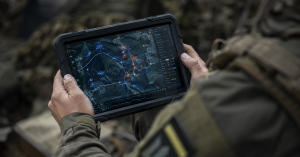
In 2023, Russia began trying to change this. 4G modems were found on some drones, and these solutions later evolved into standardized telemetry systems. In 2025, Gerans also began using mesh-network modems, allowing drones to exchange information and maintain communications over distances.
This also changed the role of the Geran itself. A drone no longer necessarily has to fly directly to a predetermined location. Instead, it can transmit telemetry, receive new commands during flight, and send video.
Cameras and Seekers: How the Geran Attacks Moving Targets
Later, Russia equipped the Geran with cameras, changing the types of targets the drones could attack.
Different versions of the Geran have been found with cameras of varying complexity, ranging from standard off-the-shelf surveillance cameras to thermal imaging systems with laser rangefinders and computer vision capabilities.
This makes it possible to attack targets without relying solely on predetermined coordinates.
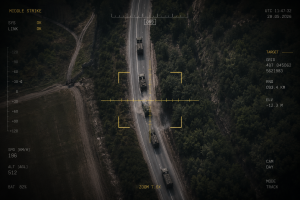
For a stationary target, knowing its location is enough. But the coordinates of a car, ship, or other moving target may become outdated within minutes. A camera and an automatic recognition system allow the drone to search for a target while in flight.
This led to modified versions informally known as “seekers,” from the English word seeker. These versions combine cameras, communication equipment, and machine-vision algorithms. An operator can confirm the target, after which the system tracks it automatically.
What Payloads Does the Geran Carry? Mines and FPV Drones
Russia has also modified the Geran’s payload.
Instead of a single warhead, some versions have been fitted with more powerful charges, different types of warheads, and additional munitions.
For example, anti-tank mines were found suspended beneath the wings of some drones in 2025. In 2026, even more unusual configurations appeared: some Gerans were found carrying FPV drones that could be released during flight.
Read also: The Evolution of Shaheds: How Russia Scaled Its Drone Warfare
How Fast Are the Geran-3, Geran-4, and Geran-5?
The most noticeable change, however, has been speed.
The basic Geran-2 used a piston engine and was significantly slower than the newer jet-powered versions. As Ukrainian air defenses and interceptor drones became more effective against these targets, Russia began switching to turbojet engines.
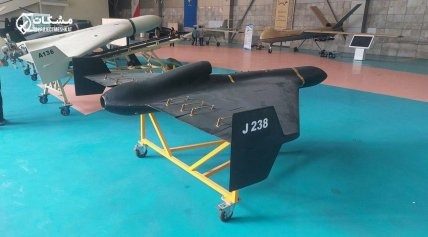
- Geran-3: This was the first jet-powered version, developed from Iran’s Shahed-238. According to Ukrainian intelligence, it has a Chinese turbojet engine and can reach speeds of 300–350 km/h.
- Geran-4: The next version has a reinforced structure and a more powerful engine, allowing it to reach speeds of nearly 500 km/h.
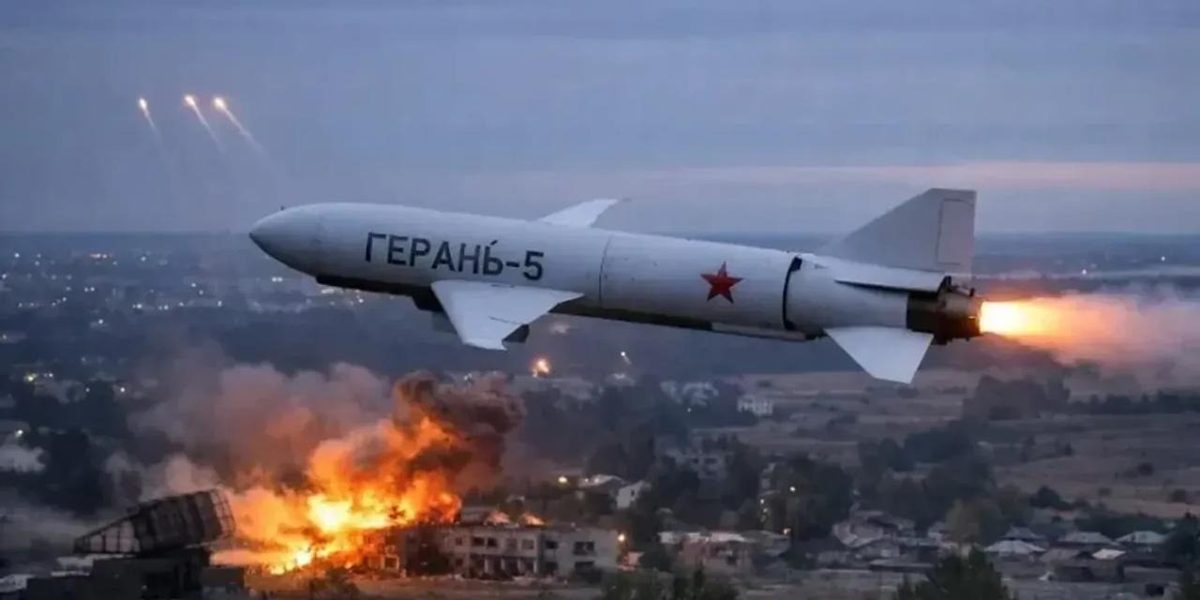
- Geran-5: This model differs significantly from the conventional Shahed design. Its shape more closely resembles a cruise missile, and its speed can reach 600 km/h.
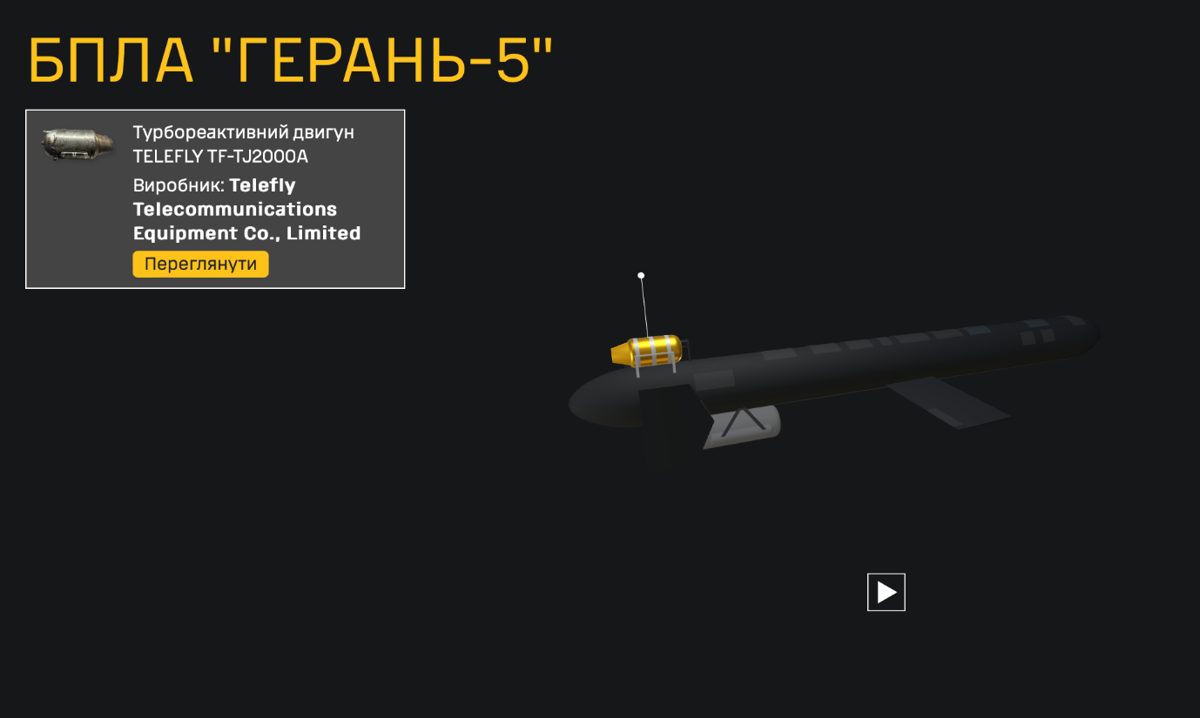
This process can be described as a continuous cycle: Ukrainian defenses find a way to counter a particular version of the drone, Russian manufacturers modify the Geran again, and the new version enters production and is deployed in combat.
The jet engine has become the next step in this race.
Why Jet-Powered Drones Are So Difficult to Intercept
For an air defense system, the detection range is not the only important factor. The time between detecting a target and intercepting it matters just as much.
The faster a drone moves, the less time there is to track it, transmit its coordinates, guide an interceptor toward the correct flight path, and carry out the interception itself.
This significantly limits the capabilities of mobile fire teams.
According to military correspondent Andrii Tsaplienko, machine-gun crews may have around 60 seconds to react when a conventional Shahed attacks. When dealing with a jet-powered drone, they may have only about six seconds.
Acting head of the Kyiv City Administration Andrii Tkachov says a jet-powered Shahed needs just three minutes to cross Kyiv.
Flight altitude creates another challenge. Aviation expert Bohdan Dolintse says jet-powered drones can fly at altitudes of 5–7 kilometers. At these heights, they become less accessible to some short-range air defense systems, while the use of electronic warfare also becomes more difficult.
This means that countering a jet-powered Shahed increasingly resembles intercepting a small cruise missile. For interceptor drones, this creates new speed requirements.
Oleksii Babenko, founder and CEO of Vyriy Industries, explains that an interceptor flying at 250 km/h cannot physically catch up with a target moving at 400–500 km/h.
Even a speed of 400 km/h may not be enough. To intercept a faster drone, an interceptor needs a speed advantage—the mere ability to fly at roughly the same speed is not enough.
However, the interceptor’s speed is only one factor. Even if it can reach the required maximum speed, that alone is not enough. It must rapidly gain altitude, cover the distance to the target, and reach the right interception trajectory.
The faster both aircraft move, the less time remains for each of these steps.
Simply making the interceptor faster will not solve the problem. It must be able to maintain high speed for an extended period, remain controllable at that speed, and use a guidance system that can respond within a matter of seconds.
Babenko also points to another problem in Ukraine’s research and development (R&D). According to him, some interceptors were built using readily available components rather than having their propulsion systems optimized for specific speed requirements.
This matters because increasing speed is not simply a matter of installing a more powerful engine. The motor, propeller, speed controller, battery, aircraft weight, and aerodynamics must all work together.
Otherwise, an interceptor may have a high maximum speed on paper but be unable to maintain it for long enough or remain easy to control.
This problem has already emerged during tests of new Ukrainian interceptors. Reuters reported that some aircraft had difficulty remaining controllable at speeds above 400 km/h.
As a result, Ukrainian manufacturers must solve several problems at the same time:
- Increase interceptor speed.
- Maintain sufficient flight endurance.
- Ensure maneuverability.
- Develop guidance systems.
- Keep the cost low enough for mass production and widespread use.
Another problem remains.
In winter 2026, then-Defense Minister Mykhailo Fedorov publicly warned that Ukraine needed to prepare for jet-powered Shaheds. But there is a time gap between recognizing a threat and producing a working system in large numbers.
It is not enough to come up with a design. The system must be tested, the best components must be identified, production must be organized, and sufficient quantities must be supplied.
This time gap could become one of the main challenges in the race between jet-powered drones and the systems designed to intercept them.
Russia is gradually upgrading its attack drones, from faster engines to new communication systems, cameras, and automatic targeting capabilities. Ukraine must not only develop interceptors but also scale up their production before each new feature of a Russian drone becomes a battlefield advantage.
Read also: Can Interceptor Drones Protect Ukraine’s Skies?
How Ukraine Is Preparing Its Response to Jet-Powered Drones
The challenge of countering jet-powered Shaheds is not limited to their speed.
Ukraine increasingly has to use fighter aircraft, including F-16s, Mirages, and MiG-29s, as well as more expensive ground-based air defense systems to destroy them. However, these resources were already in short supply even before the emergence of jet-powered drones.
On September 14, Volodymyr Zelenskyy said that Ukrainian F-16s had used AIM-9 and AIM-120 missiles to destroy jet-powered drones.
According to him, this is an expensive interception method, used when no other means of destroying the target are available.
The President also announced a Ukrainian-Canadian project to develop a low-cost missile against jet-powered drones, which was planned to be tested in Ukraine.
In other words, one of the main tasks now is to find a cheaper solution that can be used against large numbers of fast-moving drones. It is in this context that Ukraine is developing high-speed interceptor drones.
On September 18, it was reported that interceptor drones developed by at least two Ukrainian companies had been combat-proven, with confirmed shootdowns of jet-powered Shahed drones.
On September 19, Zelenskyy released footage showing an interceptor drone operated by the Security Service of Ukraine’s Military Counterintelligence Department pursuing and destroying a Geran-5. The interceptor successfully engaged a target twice that same day.
On September 24, during his address to the United Nations, Zelenskyy announced the successful testing of four new jet-powered interceptors and the start of efforts to increase production.
The following day, a meeting of Ukraine’s Supreme Commander-in-Chief’s Staff specifically reviewed the interceptor test results, the proportion of targets successfully hit, and the experience of crews already operating against jet-powered drones.
Based on the test results, officials selected systems intended to strengthen Ukraine’s air defenses. The next task is to increase their production.
As of October 2, testing was still underway, with five models in development. One was already being prepared for serial production, with around 400 units potentially ready by the end of October. The other four were still undergoing testing.
Some interceptors are already being used in combat.
For example, Ukraine’s Sting S interceptor, developed by Wild Hornets, has destroyed around ten jet-powered Geran-4 drones and several Geran-5 drones.
The company has said that the system is still undergoing active combat testing, so its specifications may change before mass production begins.
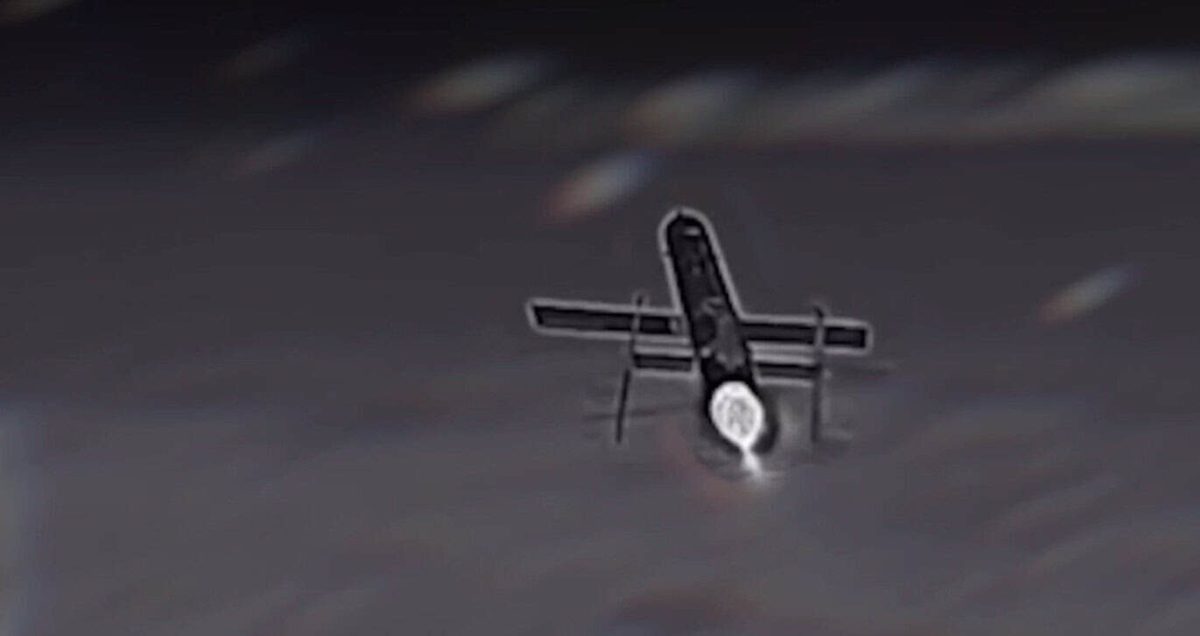
Another Ukrainian interceptor, the P1-SUN JetKiller developed by SkyFall, has reportedly destroyed a Russian Geran-5 for the second time, according to the company.
The latest interception took place on a head-on, crossing trajectory. Instead of chasing the target from behind, the interceptor approached it from the opposite direction.
However, high-speed interceptors are not the only part of Ukraine’s defense system.
On October 5, Ukrainian Air Force spokesperson Yurii Ihnat reported that Ukrainian forces had already managed to shoot down jet-powered drones, including the Geran-5, using AI-powered robotic turrets. These systems use machine vision to automatically track targets and engage fast-moving unmanned aerial vehicles (UAVs).
At the same time, Ihnat noted that the turrets have a limited operating range because their primary weapons are machine guns. They are therefore considered one component of a combined defense system rather than a replacement for other air defense assets.
According to the spokesperson, Ukraine also uses fighter aircraft, self-propelled anti-aircraft guns, mobile fire teams, and interceptor drones against jet-powered drones.
The deployment of these turrets has already begun in Kyiv.
On October 4, Zelenskyy announced that more than 12 systems designed to counter jet-powered UAVs had been installed in the capital. Another eight automatic combat modules were planned for the Kyiv region.
These systems include turrets designed to carry machine guns with a caliber of 12.7 mm.
Read also: Beyond the Military: The Rise of Private Air Defense in Ukraine
Another area of development is expanding ground-based air defense capabilities.
Military expert and 413th Regiment servicemember Ivan Kyrychevskyi names adapting the Strela-10, Osa-AKM, and Desna systems to fire Luch Design Bureau missiles as potential countermeasures.
Ukraine is also developing cheaper missiles equipped with homing heads.
Valerii Borovyk, founder of First Contact, says Ukraine needs systems affordable enough to be used against large numbers of jet-powered drones. He also emphasizes the need to continue developing electronic warfare systems that can interfere with drones’ ability to guide themselves toward their targets.
Ukraine’s response is therefore gradually taking shape as a multilayered defense system.
Some targets are to be intercepted by high-speed drones, others by conventional air defense systems, while electronic warfare can disrupt certain threats.
However, the main challenge remains scale. A single successful interceptor cannot solve the problem as the number of jet-powered drones continues to grow.
Scaling up production is not straightforward either. At this stage, component shortages are becoming a problem.
According to Zelenskyy, engines for high-speed interceptors remain one of the main bottlenecks. Ukraine manufactures some of them domestically, but current production volumes are insufficient, leaving manufacturers heavily dependent on imports.
Ukraine is therefore also working to develop domestic production of different types of jet engines.
Will Ukraine Be Able to Scale Up Interceptor Production in Time?
Russia is rapidly increasing production of jet-powered drones, from 450 in June to 2,850 in August.
Ukraine is only moving from testing to mass production, while engine supplies remain the main constraint.
The key question is whether Ukraine can scale up production of high-speed interceptors quickly enough to match the pace at which Russia is deploying jet-powered drones.
Jet-Powered Shaheds: Key Facts
These are attack drones from the Shahed/Geran family equipped with jet engines. The newer models are faster than conventional Shaheds and, in some respects, approach the capabilities of small cruise missiles.
They fly faster and, in some cases, at higher altitudes. This reduces the time air defense systems have to detect a target, track it, and destroy it.
Yes. Ukrainian interceptors have already recorded confirmed kills against jet-powered Geran drones, including the Geran-4 and Geran-5.
However, speed is not the only important factor. Interceptors must also be maneuverable, controllable, and equipped with an effective guidance system.
Ukraine is using a combination of systems: fighter aircraft, ground-based air defense, interceptor drones, robotic combat modules, and electronic warfare.
Cheaper interception methods are also being developed.
Speed is only one requirement.
An interceptor must remain controllable at high speeds, have sufficient flight endurance, and use a guidance system capable of responding within a very short time.