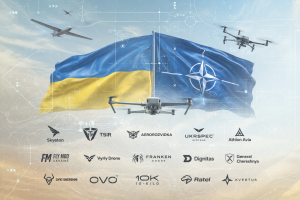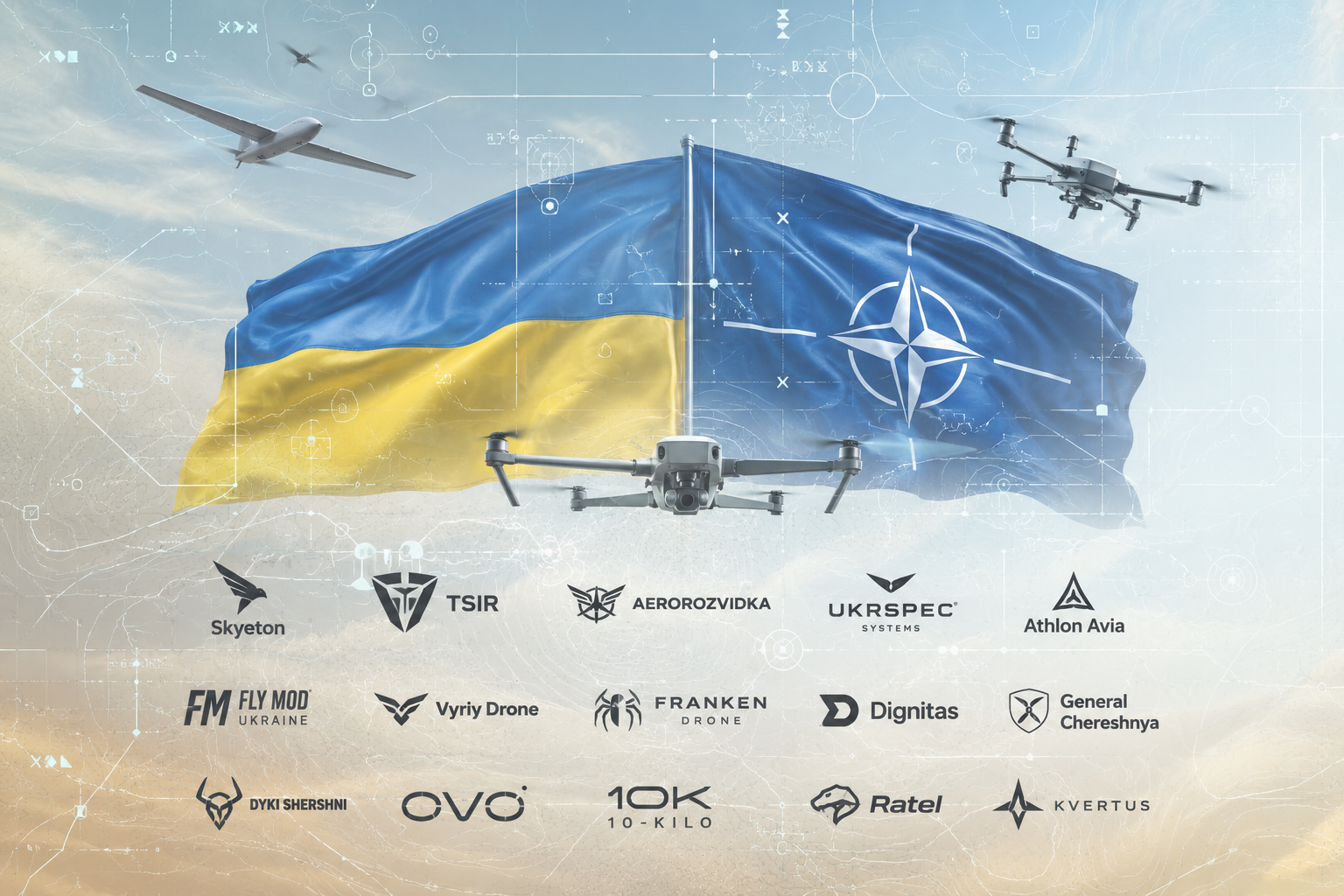
Ukrainian military technologies — from drones to electronic warfare systems — are already being produced in Germany, Finland, and the Netherlands, and are being used by the United States and NATO. This is no longer just about exporting finished drones or purchasing individual systems. Ukrainian developments are beginning to be manufactured in European countries, used by the U.S. military, and integrated into the defense systems of partner countries.
Where Ukrainian drones and electronic warfare systems are already being used, which countries are launching joint production, and why the U.S. and NATO want to adopt the very architecture of Ukraine’s digital military command-and-control system — we explain in this VGI-9 report.
If Western partners previously supplied the Armed Forces of Ukraine with their own weapons systems, today the direction of technological exchange is increasingly moving in the opposite direction.
Ukrainian Technologies on NATO’s Front Line: Where Ukrainian Military Developments Are Already Being Used
Sky Map in Saudi Arabia: How a Ukrainian System Is Protecting a U.S. Base
One of the most telling examples is Sky Map, a system developed by the Ukrainian company Sky Fortress. In April 2026, it became known that U.S. forces had deployed the Ukrainian system at Prince Sultan Air Base in Saudi Arabia. It is being used to counter drones following a series of attacks on U.S. military facilities in the region.
The facility, located approximately 640 km from Iran, had been subjected to sustained attacks involving Shahed drones and cruise missiles. As a result, the base suffered significant losses. On March 27, an E-3 AWACS early-warning aircraft was destroyed; another strike damaged several KC-135 tanker aircraft, while other attacks resulted in the destruction of aircraft and the death of a servicemember.
In response to the Iranian threat, traditional U.S. systems, such as Northrop Grumman’s FAAD platform and RTX’s Coyote interceptors, faced the challenge of being overwhelmed by large numbers of low-cost Shahed-type attack UAVs. Ukrainian technologies became one of the solutions for strengthening the base’s defenses.
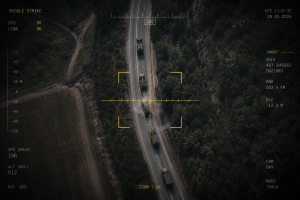
Sky Map is not simply an individual sensor or interception tool. It is a command-and-control platform that creates a unified digital picture of the air situation by combining data from radars, acoustic sensors, and other sources. The system makes it possible to detect aerial targets, track their movements, and coordinate further actions.
One of the key components of Sky Fortress’s technology is its extensive network of acoustic sensors, which the company has deployed across Ukraine. The network consists of more than 14,000 sensors capable of detecting Russian drones even at low altitudes, where they are more difficult to detect using radar.
Each sensor costs approximately $400–1,000. It detects the distinctive sound of a drone and determines the direction from which it is approaching. Data from several sensors allows the system to determine the target’s location through triangulation.
At the same time, there is no confirmation that this particular network of more than 14,000 acoustic sensors has been deployed at Prince Sultan Air Base.
According to sources, Ukrainian military personnel also arrived at the base to train U.S. servicemembers in how to operate the system. For Ukraine, Sky Map has already become one of the tools used to counter Russian attack drones. Now, the experience gained through constant attacks is being applied thousands of kilometers away from the Ukrainian front line.
It is particularly notable that as recently as March 2026, Donald Trump publicly rejected Volodymyr Zelenskyy’s offer to help counter Iranian drones. Yet just a few weeks later, the U.S. military began using Ukrainian technology at one of the key U.S. bases in the Middle East.
Ukrainian Military Personnel in the Middle East: Fighting Shahed Drones
The success of Sky Map in Saudi Arabia is not an isolated case. At the same time, Ukrainian specialists themselves have begun arriving in the region, sharing their experience of fighting Shahed drones directly with partners.
On March 17, 2026, speaking before the Parliament of the United Kingdom, Volodymyr Zelenskyy said that 201 Ukrainian military experts were already in the countries of the Middle East and the Persian Gulf.
Ukrainian teams worked in the United Arab Emirates, Qatar, and Saudi Arabia, and were also preparing to work in Kuwait. Their main task was to help partners defend themselves against Shahed drone attacks.
On March 20, Zelenskyy announced that the mission was being expanded. Ukraine sent specialized units to five countries — the UAE, Saudi Arabia, Qatar, Kuwait, and Jordan. According to him, the number of specialists in the region had increased to 228.
Local air-defense systems had been focused primarily on the threat of ballistic missiles. Ukrainian specialists, by contrast, were working specifically on the problem of mass attacks involving low-cost attack drones.
“I believe that no one has experience comparable to ours. We are working with the Middle East — with leaders, at the technical level, and with defense ministries. Overall, we are preparing serious agreements and deals,” Volodymyr Zelenskyy said.
Ukrainian teams brought to the region not only practical experience, but also their own technologies for countering drones.
In April 2026, the Head of State said that eleven countries had approached Ukraine for advice on fighting low-cost attack drones. The countries interested in Ukrainian developments included the United States. Ukrainian specialists were also sent to a U.S. military base in Jordan.
That same month, a concrete result of these negotiations became known. Ukraine signed three major security agreements — Drone Deals with Saudi Arabia, Qatar, and the United Arab Emirates. According to Zelenskyy, the agreements provide for further implementation through a series of contracts with Ukraine’s private and public sectors.
The issue is not only the supply of finished drones. Ukraine plans to share its combat experience with partners, conduct training missions, provide software for integrating different types of military equipment into a single system, and develop joint production of low-cost drones and interceptors.
In particular, Zelenskyy explained the economics behind this approach: expensive missiles should not be the main means of countering low-cost attack UAVs. Instead, much cheaper interceptors can be used to destroy them.
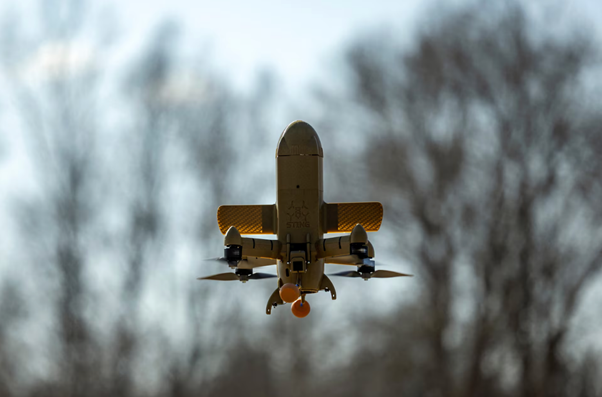
The Ukrainian Sting interceptor drone. Photo: “Diki Shershni”
Thus, Ukraine’s experience of fighting Shahed drones is gradually becoming a separate export product. And this is no longer simply about selling drones or individual systems, but about transferring something much more complex — practical experience of modern warfare.
Ukraine is effectively exporting a model for countering a threat that it has developed and tested under constant attacks: how to detect large numbers of low-cost drones, how to quickly share information between units, what means to use to intercept them, and how to avoid spending a missile that costs tens or hundreds of times more to destroy each Shahed.
Read also: From Experiments to a System: How Ukraine Is Scaling Up Interceptor Drones.
UNWAVE Electronic Warfare System at NATO’s Baltic Trust 26 Exercise
Another area is electronic warfare systems. Here, Ukrainian experience is particularly valuable because of the scale at which drones are used on the battlefield. The Russian-Ukrainian war has turned electronic warfare into one of the key elements of modern combat: it is necessary not only to detect a drone, but also to quickly identify its control, navigation, or data-transmission channel and jam it.
Ukrainian developers have been creating such systems amid a constant technological race. The adversary changes frequencies, protocols, and methods of control, while Ukrainian manufacturers respond by modifying their systems. This ability to adapt quickly has become one of the reasons for international partners’ interest.
A telling example was NATO’s Baltic Trust 26 exercise in Latvia in August 2026. During the Jamming Performance Challenge, the Ukrainian electronic warfare system developed by UNWAVE was the only system that managed to jam a drone to the point where it lost control and crashed. Following the tests, the Ukrainian development received a special award from the organizers.
Other systems developed by the company were also tested during the exercise — the Patelnia, Choven, and Shatro electronic warfare systems, as well as the Bashur drone detection system. In other words, this was no longer a demonstration of a single system, but a test of an entire counter-UAV system.
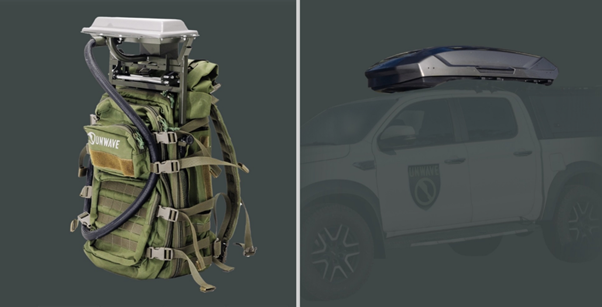
Patelnia and Choven electronic warfare systems. Photo from the UNWAVE website
This is also important from the standpoint of interoperability. In May 2026, UNWAVE software demonstrated compatibility with NATO’s C-UAS digital architecture under the STANREC 4869 standard during the Technical Interoperability Exercise. The system was also integrated with ten modules from other manufacturers.
Thus, Ukrainian experience is gradually moving from a “technology created for its own front line” to a solution being tested within the NATO environment.
Production of Ukrainian Drones Abroad: Germany, Finland, Denmark, the Netherlands
The logical continuation of this process is when partners adopt not only the experience and individual systems, but the production itself. Defense technologies that Ukraine has tested on the battlefield are increasingly being manufactured on a larger scale directly in other countries.
This is no longer simply about purchasing finished equipment or exchanging experience. Ukrainian companies are transferring technologies, licenses, and manufacturing expertise to their partners, while European companies provide industrial capacity, automation, and the ability to scale production in safer conditions.
Production of “Zum” and “Linza” Drones in Germany (Quantum Systems)
One of the first large-scale examples was the partnership between Ukrainian Frontline Robotics and German Quantum Systems. As early as July 2025, Quantum Systems acquired a 10% stake in Ukrainian company Frontline, with the option to increase its stake to 25%. At the time, the partners also announced plans to integrate Ukrainian technologies into their own systems and expand production in Europe.
In December 2025, the companies moved from investment to joint production. They established Quantum Frontline Industries as part of the Build with Ukraine initiative.
At the German facility, the companies decided to mass-produce two Ukrainian developments by Frontline Robotics — the “Zum” reconnaissance quadcopter and the “Linza” bomber drone, both of which had already been used on the battlefield.
The cooperation model involved a clear division of responsibilities: Quantum Systems was responsible for production infrastructure, equipment, and automation, while Frontline provided the technology and licenses and trained the personnel.
In this way, the Ukrainian development gained access to German industrial production capacity.
Production was launched in the first quarter of 2026, and by the end of March, Quantum Frontline Industries had delivered its first batch of drones to Ukraine. In May, it became known that the joint venture was scaling up production to 10,000 multipurpose quadcopters.
In April, Quantum Systems announced plans to establish two more joint ventures with Ukrainian defense manufacturers.
Finland: Production of Airlogix Drones and TerMIT Robots
In August 2026, a similar model began to expand to Finland. On August 19, Finnish company Innokas and Ukrainian Airlogix signed a letter of intent to establish production of Ukrainian drones in Finland.
The planned production will be based on unmanned systems developed by Airlogix and already tested in combat conditions. The Ukrainian company will provide its Finnish partners with technological expertise and know-how, while the new production facility is expected to increase the supply of drones to the Armed Forces of Ukraine.
Insta and Tencore: TerMIT Robotic Systems
Another area is ground-based robotic systems. In February 2026, Finnish technology company Insta and Ukrainian company Tencore agreed to localize production of TerMIT robotic platforms in Finland. The plan involves not only assembling the equipment, but also developing the production chain and jointly working on the integration of artificial intelligence and autonomous functions.
On August 23, it became known that the companies also intended to establish a joint Ukrainian-Finnish production facility for TerMIT 2.0 robotic systems together with Insta.
The initial goal of the future joint venture is to produce 320 systems for the needs of the Ukrainian Defense Forces. Production is planned under a distributed model involving Finnish industrial partners.
Patria and “General Chereshnya”: Joint Drone Production
The following day, August 24, Finnish defense company Patria and Ukrainian manufacturer “General Chereshnya” signed a memorandum of understanding on the joint development and production of defense drones in Finland.
“General Chereshnya” has its own experience in mass-producing FPV drones, fiber-optic drones, interceptor drones, and reconnaissance systems. Patria, for its part, has significantly greater industrial capabilities and works with the defense markets of NATO countries.
Denmark: TAF Industries and Upteko to Launch FPV Drone Production
Following the same principle — exchanging technologies rather than simply supplying finished products — cooperation is also developing between Ukrainian TAF Industries and Danish Upteko. On August 19, 2026, the companies signed a memorandum on strategic industrial cooperation in the field of unmanned aerial systems.
The partners plan to jointly develop and manufacture unmanned aerial systems, including FPV drones. Production is expected to start in early 2027, with planned output reaching thousands of drones per month.
The Netherlands: Production of Baton and K4 Attack Drones
Ukrainian technologies are also being scaled up in the Netherlands. In May 2026, plans were announced to launch joint production of the Ukrainian Baton and K4 drones. In June, Mykhailo Fedorov announced a broader program for the production of Ukrainian medium- and long-range attack drones.
According to him, under the Build with Ukraine initiative, production of Ukrainian mid-strikeand deep-strike systems is to begin in the Netherlands. The Dutch Ministry of Defense plans to finance this area.
At the initial stage, all production capacity will be dedicated to meeting Ukraine’s needs.
| Country | Ukrainian Partner | Local Partner | Product | Start | Scale / Goal |
| Germany | Frontline Robotics | Quantum Systems | “Zoom”, “Linzа” | Q1 2026 | Scaling up to 10,000 drones |
| Finland | Airlogix | Innokas | Airlogix UAVs | After August 2026 | Production is planned to be localized in Finland to increase drone supplies to Ukraine |
| Finland | Tencore | Insta | TerMIT 2.0 | 2026 | The initial goal is 320 systems for the Ukrainian Defense Forces |
| Finland | “General Chereshnya” | Patria | Defense drones | After August 2026 | Joint development and production |
| Denmark | TAF Industries | Upteko | FPV drones | 2027 | Plans to produce thousands of drones per month |
| Netherlands | Ukrainian manufacturers | Dutch partners | Baton, K4, mid-/ deep-strike | 2026 | At the initial stage, all products will be intended for Ukraine’s needs |
DELTA: Why NATO Wants to License Ukraine’s Military Command-and-Control System
Production of drones abroad is already a second level of technology export, where partners adopt the technology together with a license. But there is also a third, deeper level: rather than buying a finished development or setting up its production, partners adopt the very approach Ukraine uses to conduct technological warfare. This is primarily about digital military command and control.
DELTA: Is the U.S. Going to License Ukraine’s Military Command-and-Control System?
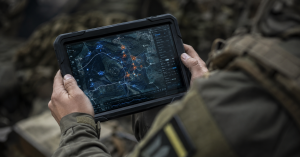
One of the most telling examples is DELTA,Ukraine’s situational awareness system. It combines a digital map, data from drones and other sensors, secure information exchange, target planning, and fire control. Its purpose is to reduce the time between detecting a target, transmitting the information, and striking it.
We previously wrote in greater detail about the Ukrainian Armed Forces’ software, from DELTA to Army+.
It is DELTA’s architecture that has attracted the attention of the U.S. military. In March 2026, the Modern War Institute at West Point published an article by U.S. Army senior officer James Andreasen. After six months working with the Security Assistance Group–Ukraine, he proposed that the U.S. Army enter into a licensing agreement and deploy the DELTA system. In his view, four years of using the system under real combat conditions, electronic warfare, and cyberattacks have given Ukraine experience that U.S. programs do not have.
As early as May 2026, U.S. Secretary of the Army Dan Driscoll said that DELTA can connect drones, sensors, and weapons platforms into a single network. For the U.S. Army, which is also working to develop a similar integrated system, Ukrainian experience has become an area of direct study.
Interest in DELTA has not been limited to the United States. In April 2025, Ukraine reported receiving a request from one of its NATO partner countries to export the system. At the time, the Ministry of Defense was considering various models for transferring the technology, including licensing. The system has also repeatedly demonstrated compatibility with NATO standards.
During the CWIX24 exercise in Poland, DELTA was integrated with Poland’s TOPAZ artillery fire-control system. The Ukrainian system transmitted data on the positions of its own and friendly forces, demonstrating its ability to serve as a hub for collecting and processing information. Overall, during the exercise, the DELTA team tested interoperability with various combat systems used by NATO countries.
The reason for this interest is combat experience. The Ukrainian system has evolved under constant Russian electronic warfare, cyberattacks, the massive use of drones, and the need to operate even when communications are unstable. This is why it is being viewed not simply as another military software system, but as an example of what the digital architecture of modern warfare could look like.
Ukrainian military developers emphasize that Western armies simply did not have such modules before, because no NATO country had experienced full-scale warfare involving such a large number of drones before the full-scale invasion. That is why Ukraine is creating solutions not for some abstract future conflict, but for problems that are already emerging on the battlefield.
DELTA demonstrates a broader trend: Western partners are now interested not only in individual Ukrainian products, but in the architecture behind them — the way intelligence, software, drones, and weapons can be combined into a single system. This experience is becoming one of Ukraine’s most valuable technological exports: it cannot simply be purchased together with a finished drone. It was developed under the conditions of a real war and constant adaptation to the adversary’s actions.
Read also: Starlink in the War: How Does It Work and Is There a Replacement?.
Ukrainian Technologies Abroad: Key Facts
What is Sky Map and where is it used?
Sky Map is a Ukrainian system developed by Sky Fortress that combines data from radars, acoustic sensors, and cameras into a single picture of the air situation. Since April 2026, it has been used by the U.S. military at Prince Sultan Air Base in Saudi Arabia to protect against Shahed drones.
How many Ukrainian specialists are working in the Middle East?
As of March 2026, there were 228 Ukrainian military specialists in the region. They work in the UAE, Saudi Arabia, Qatar, Kuwait, and Jordan, helping partners defend against Shahed drone attacks.
Where are Ukrainian drones already being produced abroad?
Joint production has been launched or agreed upon in Germany (Quantum Frontline Industries), Finland (Airlogix, Tencore, General Chereshnya), Denmark (TAF Industries), and the Netherlands. The largest scale is planned in Germany, where production is expected to reach 10,000 drones.
Will foreign militaries license DELTA?
The issue remains open. In March 2026, a U.S. Army officer publicly proposed entering into a licensing agreement for DELTA, while the U.S. Secretary of the Army praised the system’s capabilities. A request to export DELTA had also been received from one of the NATO countries back in 2025.
How does Ukrainian electronic warfare differ from Western counterparts?
The main advantage is the speed of adapting to new enemy frequencies and protocols, developed through real combat experience. During NATO’s Baltic Trust 26 exercise, the UNWAVE system was the only one that successfully managed to jam a drone during the Jamming Performance Challenge.
Why are partners particularly interested in Ukrainian experience?
Before 2022, no NATO army had experience conducting combat operations under constant, large-scale attacks by cheap strike drones. Ukrainian systems were developed under conditions of real electronic warfare, cyberattacks, and unstable communications — experience that no other army in the world has.